

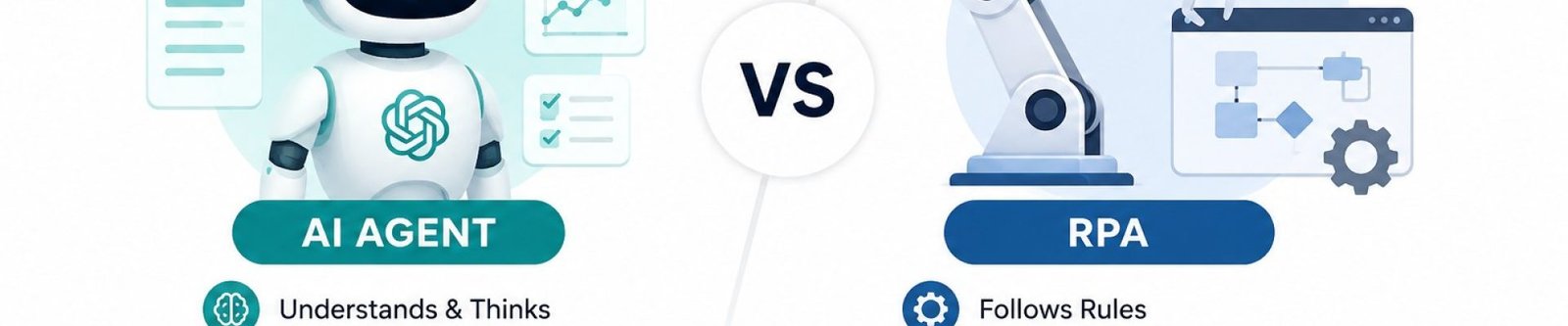
AI Agent vs RPA Small Business: The Honest, Proven Guide for 2026

Every automation article online is written for enterprise IT teams comparing six-figure platforms. If you're weighing up AI agent vs RPA small business options — or whether that's even the right question — this is the guide written for you instead.
What Is RPA? An AI Agent vs RPA Small Business Primer
RPA (Robotic Process Automation) is software that follows a fixed set of steps, the same way every time — click here, copy this, paste it there, send the email. Think of it as a very fast, very reliable digital assistant that does exactly what you told it to, and nothing more.
RPA is brilliant at structured, repetitive tasks: copying data between two systems, generating an invoice from a template, or moving a file from one folder to another. As TechTarget explains, RPA excels specifically at predictable, well-defined workflows with consistent data formats. Microsoft Power Automate — which we cover in detail in our Power Automate vs Hiring comparison — is the RPA-style tool most Australian small businesses are already using without realising it.
The catch: if the process changes even slightly, RPA breaks. It has no judgement — it can't read an email and decide what it actually means.
What Is an AI Agent, in Plain English?
An AI agent is different. Instead of giving it a fixed script, you give it a goal — and it figures out the steps itself, using judgement along the way. It can read an unstructured email, understand what the customer actually wants, and decide what to do next, even if it's never seen that exact wording before.
We go deeper into how this actually works in AI Agents Explained. The short version: an AI agent doesn't just follow a script — it reasons, adapts, and takes real action across your business systems.
AI Agent vs RPA Small Business Comparison: Side by Side
Here's the honest breakdown, without the enterprise jargon:
| Factor | RPA | AI Agent |
|---|---|---|
| Best for | Structured, repetitive, rule-based tasks | Unstructured tasks needing judgement |
| Data type | Consistent, predictable formats | Emails, documents, varied language |
| Flexibility | Rigid — breaks if the process changes | Adapts to new situations |
| Setup cost | Lower, often included with Microsoft 365 | Higher one-off setup investment |
| Reliability | Very high for defined tasks | Strong, but needs human review points |
| Example | Copying invoice data into your accounting system | Reading a quote request and creating the job order |
Which One Does Your Small Business Actually Need?
This is the real AI agent vs RPA small business question. Forget the jargon. Ask yourself one question: does the task follow the exact same steps every single time, or does it require reading something and deciding what to do?
Use RPA when...
You're copying data between two systems, generating the same report every week, or processing invoices that always arrive in the same format.
Use an AI Agent when...
You're reading customer emails and deciding what to do, qualifying leads from varied enquiries, or handling requests that never look quite the same twice.
Real example: One of our clients, Tekton Solutions, uses an AI agent to automatically update their pricing list — a task that involves reading varied supplier data, not just copying fixed fields. Another client, Vieira Cleaning Services, uses an AI agent to capture and process incoming Google leads, since every enquiry reads differently. Neither of these would work well as a rigid RPA flow.
Real Cost Comparison for Small Business
This is the part most enterprise-focused AI agent vs RPA articles skip entirely. Here's what it actually costs an Australian small business to get started with each:
- Basic flows included with Microsoft 365
- Premium: ~$22 AUD/user/month
- Implementation: $2,000–$8,000 one-off
- Best for high-volume, simple tasks
- Setup starting from $4,200
- Scoped to the specific workflow
- No per-user licensing to stack up
- Best for judgement-based, varied tasks
Book a free 30-minute discovery call. Tell us the task, and we'll tell you honestly whether it needs RPA, an AI agent, or neither.
Book Free Discovery Call →Can You Use Both Together?
Yes — and for most AI agent vs RPA small business decisions, this is actually the smartest approach, not a compromise. Let RPA handle the structured, repetitive part of a process, and let an AI agent handle the part that needs judgement.
In practice, that might look like an AI agent reading an incoming quote request and deciding how to categorise it, then handing off the structured data entry to a simple automated flow.
This is exactly how we've built solutions like the automation workflows covered in our repetitive tasks guide — combining the reliability of rule-based automation with the flexibility of AI where it's actually needed, rather than defaulting to one or the other.
Frequently Asked Questions
RPA follows fixed, predefined rules to automate repetitive tasks with structured data, and breaks if the process changes unexpectedly. An AI agent is given a goal rather than a script, and can reason, adapt, and handle unstructured information like emails or documents that don't follow a consistent format.
RPA tools like Power Automate are generally cheaper to license, often included with Microsoft 365 or costing around $22 AUD per user per month for premium features. AI agent builds typically involve a higher one-off setup cost, starting from around $4,200 with SimpleIT4U, but can automate work that RPA alone cannot handle.
Yes, and for many small businesses this is the most practical approach. RPA can handle the structured, repetitive parts of a process, while an AI agent handles the parts that require judgement, such as reading an email and deciding what action to take next.
No. Both technologies can be implemented by an external partner without requiring an in-house IT team, particularly when built on accessible platforms like Microsoft Power Automate and Power Platform.
If the task follows the same steps every time with structured data, such as copying figures between two systems, RPA is usually the right fit. If the task involves reading and interpreting varied information, such as an email, a quote request, or a document, and deciding what to do next, an AI agent is generally the better fit.